A Liberal MP was caught wearing his birthday suit in the virtual House of Commons.
William Amos, who has represented the Quebec riding of Pontiac since 2015, appeared on the screens of his fellow members of Parliament completely naked Wednesday.
A screenshot obtained by The Canadian Press shows him standing behind a desk between the Quebec and Canadian flags, his private parts hidden by what appears to be a mobile phone in one hand.
“This was an unfortunate error,” Amos said in a statement sent by email Wednesday.
“My video was accidentally turned on as I was changing into my work clothes after going for a jog. I sincerely apologize to my colleagues in the House of Commons for this unintentional distraction. Obviously, it was an honest mistake and it won’t happen again.”
Bloc Quebecois MP Claude DeBellefeuille, the party whip, raised the incident in a point of order after question period, suggesting a reminder about parliamentary decorum.
“It may be necessary to remind the members, especially the male ones, that a tie and jacket are obligatory, but so are a shirt, boxer shorts or pants,” she said in French.
“We have seen that the member is in great physical shape, but I think members should be reminded to be careful and control the camera well.”
Speaker Anthony Rota later thanked DeBellefeuille for her “observations” and clarified that while he had not seen anything, he checked with technicians and confirmed they saw something.
He reminded MPs to always be vigilant when they are near a camera and microphone.
Amos, the parliamentary secretary to Industry Minister Francois-Philippe Champagne, was visible only to MPs and staffers on an internal video conference feed. Because he was not speaking during question period, his image did not show up on the public feed.
Liberal whip Mark Holland said Amos was “utterly mortified.”
Holland said he was satisfied with the explanation from his caucus colleague.
“I don’t think there was any ill intent. It’s certainly an unfortunate circumstance,” Holland said in an interview.
“I think it’s part of the circumstances of the world we’re in right now, where the line between our home and our office place is so blurred and trying to manage that is sometimes challenging,” he added.
“This is a warning to everybody. You’ve got to really always assume that camera is on and be very careful any time you wander anywhere near that camera that you’re dressed appropriately.”
Asked if he’ll be issuing a warning to all Liberal MPs to that effect, Holland said: “Oh, big time.”

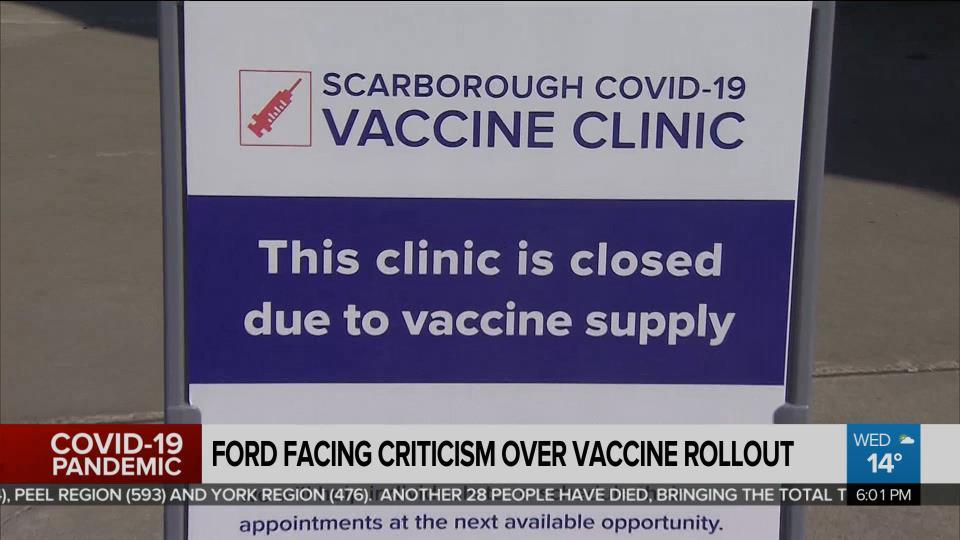
Disruptions in COVID-19 vaccine shipments to Ontario have forced several vaccination clinics to temporarily close in the midst of a troubling third wave.
WATCH: https://toronto.citynews.ca/2021/04/13/2-scarborough-covid-19-vaccine-clinics-temporarily-closing-due-to-vaccine-supply/
The following clinics are affected. Reopening dates are dependent on supply. (This list will be updated if/when other clinics are affected):
Scarborough Health Network:
- Centennial College, 941 Progress Avenue (closing April 14)
- Centenary hospital, 2867 Ellesmere Road (closing April 14)
North York General/North York Toronto Health Partners:
- Seneca College, 1750 Finch Ave E, Newnham Campus (Room G2652) (closing April 17)
Michael Garron Hospital/Toronto East Health Network:
- Thorncliffe Park Community Hub, 45 Overlea Blvd. Unit 108A (closing April 14)
York Region was also forced to close its drive-thru clinic at Canada’s Wonderland due to supply shortages and the University Health Network has paused vaccine appointment registrations for 18-49 year olds in three hotspot communities due to the shortfall.
Premier Doug Ford blames the temporary closures on delays in Moderna vaccine shipments.
Ford said 303,000 doses that were scheduled for delivery on April 5th, are now expected someone Wednesday, while the next shipment of nearly 500,000 doses that was due on the 19th is delayed until the 29th.
Toronto’s Medical Officer of Health, Dr. Eileen de Villa said Wednesday that vaccines are arriving at a “slower and less predictable rate than expected.”
“Reaching our maximum capacity to vaccinate will require more vaccine than is in the pipeline at present,” she said.

Essential workers who put food in grocery stores through the Ontario Food Terminal are pleading with the government to prioritize them for vaccinations, as more of them fall ill.
WATCH: https://toronto.citynews.ca/2021/04/13/ontario-food-terminal-covid-19-vaccinations/
The food terminal in Etobicoke is the largest distribution hub for fruit and produce in the country, and the fourth-largest in North America. Frontline workers say despite doing everything right, COVID-19 variants are still spreading rapidly.
“Does someone have to die down here before we get a couple thousand vaccines?” asks Larry Davidson, owner of North American Produce, which operates at the terminal.
The terminal is considered an essential business by the government, and has stayed open throughout the pandemic. The board that runs the terminal has put COVID-19 protocols in place, including screening, masking, cleaning and controlling how buyers move through the site, to keep the virus in check. The terminal managed to limit outbreaks and prevent spread, for a time.
“Up until these variants, which are obviously far more contagious,” says Davidson. “That’s what I had.”
He tells CityNews that in the last month, he and more than 20 per cent of his workforce have been infected with COVID-19.
“At this point it’s not really relevant how it’s being spread,” he says. “People are wearing their masks, they’re doing everything they’re supposed to no different than they did the whole year. It’s now a matter of getting people vaccinated.”
Should COVID-19 force the terminal to shut down, Davidson says Ontarians would see the impact at their grocers.
“The distribution of produce would be affected significantly in the province,” he says. More than 5,000 Ontario businesses buy fruits and vegetables at the terminal.
Open 24 hours a day, seven days a week, workers put in long hours in close quarters to get fresh produce into Ontario’s grocery stores and beyond.
“Unless you’ve been in this environment you really don’t know what it’s like, it can be a zoo sometimes,” says Curtis Millette, an inventory control manager with North American Produce. “It’s always very busy.”
Davidson’s worst fear was realized when he brought the virus home to his 10-year-old daughter and his wife. His partner has multiple sclerosis and ended up hospitalized.
“I’m heartbroken. I hope my wife recovers,” he says. “I’ll never be able to forgive myself for what I brought home, never. It eats at me every minute of every day.”
As of right now, Ontario plans to vaccinate anyone who cannot work from home in mid-May. However, many doctors are pushing the conservative government to move that date up as they see more and more essential workers end up in ICUs.
“That is part of the second phase and frankly very much dependent on supply we receive,” says Sylvia Jones, Ontario’s solicitor general. “As soon as we have sufficient supply we’re going to make sure that if you can’t work from home, you’ll have access to a vaccine.”
The government has been working with employers to set up mobile vaccine clinics at businesses in hotspots, however the food terminal isn’t in one of the 114 at-risk neighbourhoods identified by the province.
“It’s beyond frustrating,” says Davidson. “We should be ahead of people who are able to work from home.”

Toronto Blue Jays outfielder Teoscar Hernandez tested positive for COVID-19 on Tuesday, according to manager Charlie Montoyo.
Hernandez, who began experiencing symptoms on Monday, will be out at least the next 10 days.
The Blue Jays initially assigned Hernandez to the COVID-19 injured list on April 9 after he was exposed to someone who had tested positive for the coronavirus.
Now that he has tested positive himself, Hernandez “will need to complete a 10-day quarantine, demonstrate an improvement of any symptoms, undergo a cardiac evaluation and receive clearance from both team physicians and MLB’s Joint COVID-19 Health/Safety Committee” before he can re-join the team, according to Sportsnet’s Arden Zwelling.
Montoyo added that the 10-day quarantine begins on Tuesday.
The 28-year-old was last in contact with the rest of team on April 9, when he was in the lineup against the Angels, according to Sportsnet’s Shi Davidi. Since then, the rest of the roster has tested negative multiple times and many of the players and staff have begun to be vaccinated.
Hernandez, who won a Silver Slugger award last season, is hitting .207/.207/.310 with one home run in seven games this season.
In other Blue Jays injury news, George Springer’s debut with the team has been further pushed back, according to Montoyo. The team’s biggest off-season addition will now not travel on the upcoming road trip through Kansas City, Boston and Tampa, making April 27 against the Washington Nationals now the target for his first game.
Springer is currently recovering from a quad strain, which he suffered during his rehab of a spring training oblique injury.
Finally, right-hander Nate Pearson is progressing well from a spring-training groin injury and will throw one inning of live batting practice Wednesday, according to Montoyo. General manager Ross Atkins, during an appearance on MLB Network’s High Heat Tuesday, said Pearson is “pain free” and will be able to make a start once he is stretched out.
“He’s feeling incredible right now,” Atkins said.

The Public Health Agency of Canada says it has received a report of a blood clot after a Quebec woman received the Oxford-AstraZeneca vaccine.
This is the first such reported case in Canada.
Quebec says the female patient, whose age was not revealed, received the appropriate care and is recovering at home.
The vaccine was the one produced at the Serum Institute of India, known as Covishield.
Blood clots from the AstraZeneca vaccine are extremely rare but concerns about this adverse effect prompted the National Advisory Committee on Immunization (NACI) to advise provinces not to deliver the shot to anyone under the age of 55.
This comes after the United States decided to pause the use of the Johnson & Johnson vaccine also due to reports of rare blood clots. Health Canada is investigating those reports.
Health Canada asked AstraZeneca for a full risk assessment of its vaccine after reports of similar clots in Europe but says the side effect is extremely rare and the vaccine’s benefits still outweigh its risks.
More than 700,000 doses of the vaccine have been administered in Canada and the risk of getting blood clots from COVID-19 itself is far higher than from the vaccine.
Both Johnson and Johnson and AstraZeneca shots are viral vector vaccines, while the Pfizer and Moderna shots are mRNA vaccines.
The Scarborough Health Network says two of their COVID-19 vaccine clinics will have to temporarily close due to a shortage of vaccines.
A notice on their website said Centennial College and Centenary hospital clinics will be closing as of Wednesday and will reopen when they receive more vaccines.
Appointments scheduled for those locations will be cancelled and rebooked at the “earliest available opportunity.” Those whose appointments were impacted will be contacted.
“We sincerely apologize for the stress and frustration this will cause to our community,” read the statement.
These two clinics aren’t the only one that have been forced to close due shortage of COVID-19 vaccines.
York Region was forced to close their drive-thru clinic at Canada’s Wonderland and other mass vaccination clinics in the region are operating with a limited supply after the area experienced a reduction in vaccine supply stemming from delays in the Moderna shipment.
The University Health Network also paused registrations for 18-49 year olds in three hotspot communities for COVID-19 vaccine appointments due to a lack of supply.

Cracking open a cold one while enjoying one of the city’s many parks could soon become a legal reality if one Toronto city councillor gets his way.
Josh Matlow, representative for Ward 12 Toronto-St. Paul’s, will present a motion at this month’s Infrastructure and Environment Committee meeting, calling on the City to launch a pilot project to allow for the consumption of alcohol in public parks and beaches with washroom facilities.
If successful, the pilot would run from the Victoria Day long weekend until Halloween. The alcohol content of the drinks cannot be more than 15 per cent — making beer and wine an option but not hard alcohol. As well, drinking hours would be limited from 11 a.m. until 9 p.m.
“As we approach the second summer of the pandemic, public health officials recognize the reality that, especially after a year in isolation, people need to socialize,” his motion reads.
“It is up to us as policy makers to create environments where those connections with friends and family can be made in the safest way possible.”
He said many residents don’t have outdoor spaces and should not be left with unsafe options such as gathering indoors or, like many over the past year, choosing to drink illegally in parks.
To read his complete motion and recommendations, click here.
The committee meeting is scheduled for April 28.

Ontario’s stay-at-home order allows citizens to leave the house for just a handful of reasons and while outdoor exercise is included among them, simply “hanging out” in a park is not.
Kingston Police issued a release on Friday saying parks should be treated as “a walk-through or a thoroughfare rather than a destination” and that they “will not be treating sedentary activities, such as sitting or sunbathing while in parks and other recreational amenities, as exercise,” and hence they are not exempt from the stay-at-home order.
The release came in response to that city’s decision to close down Breakwater Park where hundreds of people gathered on April 8.
Police said people were generally not congregating in groups larger than five, but they were also moving, “sometimes dependent on the known presence of authorities,” and officers were unable to “form evidence of possible infractions.”
As such, the force decided on “refining its approach” and is asking people not to hang out in parks.
In the City of Toronto’s daily COVID-19 briefing, Mayor John Tory said the city would not be taking the same approach.
“Of course people are supposed to go outside and engage in safe, healthy activity,” he said. “Some of this comes down to a question of interpretation, which is sometimes in the hands of enforcement people and other times just in the hands of people looking at what the rules are.”
Tory said the city is considering repainting physical distancing circles in parks as they did last summer, to ensure people stay at a safe distance. Enforcement officers will be out and about, but the approach is to encourage people to spend time outside, safely.
“We’re not saying they should not use parks. I think what we said was – go for a walk in your own neighbourhood, don’t travel to a ‘destination park,’ … try to stay within your own local area and of course try to stay with your own family, the people that you live with,” he added.
Toronto Fire Chief Matthew Pegg added that enforcement continues to take place and teams were very active over the past weekend, “proactively inspecting and engaging with folks” as well as “reactively” responding to complaints.
He said 10 charges were laid and six notices were issued under the Reopening Ontario Act in relation to businesses and illegal gatherings, including in parks.
“The strategy for our coordinated enforcement action has not changed,” said Pegg.”Our teams are directly connected, working both proactively and working together to receive complaints, to prioritize them and triage them and to respond to them on the basis of the highest risk complaints first.”
The current outdoor gathering limit in Toronto is five people or less with physical distancing between individuals.
Earlier Monday, councillor Josh Matlow revealed he will present a motion at this month’s Infrastructure and Environment Committee meeting, calling on the City to launch a pilot project to allow for the consumption of alcohol in public parks and beaches with washroom facilities.
If successful, the pilot would run from the Victoria Day long weekend until Halloween.
With files from Maleeha Sheikh
OTTAWA — Air Canada and the federal government have agreed to loans and equity financing that would allow the airline to access as much as $5.9 billion.
WATCH: https://toronto.citynews.ca/2021/04/12/air-canada-ottawa-agree-on-5-9-billion-aid-package/
As part of the package, Air Canada has agreed to a number of commitments, including refunds for some customers who did not travel due to COVID-19 and a promise to resume service at regional airports.
Thousands of would-be passengers who paid for tickets remained in the lurch at the end of 2020. Air Canada reported it held $2.3 billion in advance ticket sales during the fourth quarter.
Other restrictions imposed as part of the deal with Ottawa include a $1 million cap on executive compensation and maintaining a minimum number of staff.
Asked whether the Air Canada agreement could provide a framework for a deal with WestJet, Deputy Prime Minister Chrystia Freeland emphasized the importance of two national carriers and characterized negotiations with the Calgary-based No. 2 airline as “constructive.”
She said ticket refunds, executive compensation and other requirements would be a factor but any deal would be based on the individual needs of the airline in question.
Travel restrictions introduced through the beginning of the pandemic have been catastrophic for the airline industry.
Air Canada’s passenger numbers declined 73 per cent in 2020 following several years of record growth for the airline. During 2020, it reduced staff by more than 20,000, more than half of the pre-COVID total, then cut another 1,700 employees in January.
The company collected $554 million from the Canada Emergency Wage Subsidy in 2020 and said it would continue to access the program in 2021.
When the airline released its 2020 financial results in February, then-CEO Calin Rovinescu described the period as the “bleakest year in the history of commercial aviation.”
The company lost $4.6-billion in 2020, compared with a profit of $1.5 billion the year before.
Government support for Air Canada “has gone from a nice-to-have, almost to a need-to-have” said RBC analyst Walter Spracklin in a Feb. 12 note analyzing the financial results.
He added that government support would be necessary for Air Canada to provide passenger refunds because the company has been so weakened by travel restrictions it no longer has the means.
“Importantly, government assistance is required in our view to lessen the burden the Canadian airline industry will have incurred by the time the pandemic is over in order to make a viable airline industry in Canada going forward,” Spracklin said.
In early April, Air Canada pulled the plug on its planned $190-million takeover of Montreal-based tour operator Transat AT, citing Europe’s unwillingness to approve the deal, thus triggering a $12.5-million termination fee.
Organizations supporting Air Canada’s calls for a bailout have included unions such as Unifor and the Canadian Air Traffic Control Association, as well as the National Airlines Council of Canada industry group.
This report by The Canadian Press was first published April 12, 2021.
Ontario is keeping all schools in the province closed for in-person learning following the current school break, Ontario Premier Doug Ford says.
WATCH: https://toronto.citynews.ca/2021/04/12/ontario-cabinet-considering-keeping-all-schools-closed-for-in-person-learning-after-april-break/
This move comes one day after Education Minister Stephen Lecce appeared to be standing firm on his plan to have in-person learning resume next week.
In a letter issued to parents on Sunday, Lecce wrote all publicly funded and private elementary and secondary schools will be open for in-person learning despite the province’s stay-at-home order.
Lecce also stood up in the legislature Monday and continued to contend schools are safe but noted rising case counts were a concern. He also said he was working with the chief medical officer of health to keep families across Ontario safe.
Students across Ontario began April break on Monday after the regular scheduled March Break was pushed back as COVID-19 cases began to climb.
The province reported a test positivity rate of 9.5 per cent on Monday, up from 7.7 per cent a day ago and 7.8 percent last week. It is the second-highest positivity rate the province has recorded since the start of the pandemic.
There was a rate of 9.7 per cent on Dec. 29 and Jan. 4 during the peak of the second wave.
Last week, Lecce said that enhanced safety measures would be put in place to protect students and staff once they were supposed to return from the April break.
“We’re going to be encouraging outdoor education. More outdoor learning where it is possible this Spring and Summer. We know it has helped us in the Fall,” said Lecce at the time.
“We’re going to be strongly urging as much education, experiential outside in our parks, in our playgrounds to make this learning experience possible but safe.”
Ford made the announcement during a press conference on Monday.
More to come

